Design rules for printing
The limits a model must meet to print, finish and ship well, with a rule ID on every number.Use this when: you design a part for a Womp print, or check whether a model will print, fit, move or survive shipping.
Don't use this for: prices, delivery times or how to place an order. Read Ordering and Shipping for those.
Womp prints in resin. These rules come from Womp's print design rules, version 3.0. Every number on these pages carries a rule ID, for example WAL-01. The same rules are published as data at /docs/data/print-rules.json.
How to read the rules
- Units are mm, g and MPa. Clearance is always per side, surface to surface (
GEN-06,CLR-01). - Every limit applies to the finished part: washed, cured, supports removed and surface finished (
GEN-01). - Mating parts are checked at their worst tolerance at the same time: the inner part oversize and the opening undersize (
GEN-04). - A feature that prints is not automatically approved. The limits are set so the part survives support removal, washing, finishing, packing, shipping and normal handling (
GEN-02).
Finish decides the rule set
| Finish | What it is | Rules |
|---|---|---|
MATTE | Sanded or media-blasted. Removes material. | The matte values |
GLOSSY | Polished, coated or dipped. Can add material. | The glossy values, plus Glossy and clear |
CLEAR | Clear resin finished glossy on every visible face. Clear ordered Matte prints frosted; see Materials and finishes. | Every glossy rule, plus the clear rules (CLA-01) |
Matte and glossy share print accuracy but not finishing (GEN-03). Coating eats clearance and fills fine detail, so glossy limits are larger.
What a result means
Each check gives one of three results. A model's result is the worst result of any check.
| Result | Meaning |
|---|---|
AUTO_PASS | Meets the automatic limit. No engineering change needed. |
REVIEW | An engineer checks it before production. It often passes with a small change. |
ROUTE | Needs engineering approval and usually a design change. It is not a rejection (GEN-05). |
A supported wall shows how one rule maps to results:
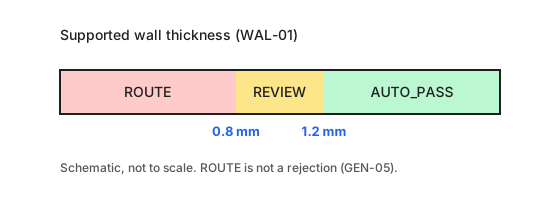
A supported wall passes automatically at 1.2 mm or more. From 0.8 mm it goes to review. Thinner than 0.8 mm it is routed to engineering (WAL-01).
Tolerance
Standard tolerance on the finished part, for every finish, is ±max(0.20 mm, 0.2 %): the greater of ±0.20 mm or ±0.2 % of the nominal size (TOL-01). Up to 100 mm the flat ±0.20 mm governs. Above 100 mm the 0.2 % governs: ±0.30 mm at 150 mm, ±0.60 mm at 300 mm.
| Rule | Name | Limit (mm, per side for gaps) |
|---|---|---|
TOL-01 | Standard tolerance | Standard tolerance = the greater of ±0.20 mm or ±0.2 % of nominal. Applies to MATTE, GLOSSY and CLEAR on the finished part. MATTE: ±max(0.20 mm, 0.2 %); GLOSSY: ±max(0.20 mm, 0.2 %); CLEAR: ±max(0.20 mm, 0.2 %). Bands: AUTO_PASS requested ≥ standard; REVIEW ±0.10 mm to standard; ROUTE tighter than ±0.10 mm. |
TOL-02 | Precision tolerance requests | Requests between ±0.10 mm and standard are REVIEW; tighter than ±0.10 mm are ROUTE and usually need post-machining (drill, ream, face). |
TOL-03 | Tolerance is not clearance | Each part meeting its tolerance does not guarantee a fit. Clearance must be designed in (CLR, CLS rules). |
TOL-04 | Geometric tolerances are not implied | Linear tolerance does not imply flatness, roundness, perpendicularity, parallelism or hole position. These must be specified and inspected separately. |
Tolerance is not clearance. Two parts that each meet their tolerance can still fail to fit, so design the clearance in (TOL-03).
The limits people need most
| Fit or feature | Matte | Glossy | Clear | Rule |
|---|---|---|---|---|
| Loose static fit, per side | 0.3 mm | 0.8 mm | 0.8 mm | CLR-02 |
| Open sliding fit, per side | 0.5 mm | 1 mm | 1 mm | CLR-04 |
| Closed pocket (box in a sleeve), per side | 1 mm | 2 mm | 2 mm | CLS-02 |
| Hanging loop, bail or keyring section | 3 mm | 3.5 mm | 3.5 mm | PRO-07 |
| Raised detail height | 0.2 mm | 0.3 mm | 0.3 mm | DET-01 |
| Engraved depth | 0.4 mm | 0.5 mm | 0.5 mm | DET-02 |
| Supported wall (passes automatically at 1.2 mm; review from 0.8 mm) | 1.2 mm | 1.2 mm | 1.2 mm | WAL-01 |
All rules by topic
- Fits and clearances: open fits, closed fits, hinges, chains, print-in-place.
- Glossy and clear: what coating does, where it pools, clear resin.
- Walls and holes: wall thickness, holes, slots, drain holes.
- Detail and lettering: raised and engraved detail, text.
- Protrusions and loops: pins, horns, fingers, handles, hanging loops.
- Strength and warping: resin, breakage at narrow necks, warping.
General principles
| Rule | Name | Limit (mm, per side for gaps) |
|---|---|---|
GEN-01 | Tolerances apply to the finished part | Every dimensional and clearance rule is evaluated on the fully washed, post-cured, support-removed and surface-finished part. |
GEN-02 | Printable is not durable | A feature that SLA can resolve is not automatically approved. Womp limits are set for survival through support removal, washing, finishing, packaging, shipping and normal handling. |
GEN-03 | Finish decides the rule set | MATTE and GLOSSY share print accuracy but not finishing. CLEAR parts are always GLOSSY (clear resin is only transparent after polishing/coating) and also follow CLA rules. |
GEN-04 | Evaluate at worst case | Mating parts are checked with each part at its worst tolerance limit simultaneously (oversize inner part, undersize opening). |
GEN-05 | ROUTE is not REJECT | A ROUTE result sends the model to engineering approval with a suggested fix. The validator never tells a customer a design is impossible on threshold grounds alone. |
GEN-06 | Units and conventions | Lengths in mm, mass in g, stress in MPa. Clearance is always per side (surface to surface). Diameters are written Ø. |
Use instead
- Wrong move: using the matte clearance on a glossy or clear part. Why: coating adds material on every face and fuses small gaps. Right move: use the glossy column, and the closed-fit value for any part inside a closed perimeter (
CLS-02). - Wrong move: treating tolerance as clearance. Why: two parts in tolerance can still jam (
TOL-03). Right move: design the per-side gap from Fits and clearances. - Wrong move: quoting a limit without its rule ID. Why: the ID is how Womp and other agents check the number. Right move: write the number with its ID, for example "1 mm per side (
CLR-04)".
Last checked: 2026-11-09. Womp version: Womp web app, November 2026.