
Glossy and clear finishes
What glossy coating does to gaps and detail, where it pools, and the extra rules for clear resin.Use this when: a part will be glossy or clear, or you are choosing between matte and glossy.
Don't use this for: matte parts. Matte follows the base values in the other rule pages.
Glossy finishing either removes material (polishing) or adds it (a clear coat or dipped resin). Coating does two things matte never does: it eats clearance, and it wicks into narrow gaps and cures solid, fusing parts together.
Glossy rules
| Rule | Name | Limit (mm, per side for gaps) |
|---|---|---|
GLS-01 | Coating eats clearance | A coating of thickness t on both mating faces removes 2t per side, i.e. 4t from a diametral clearance. Coating is thinnest on open, flat, vertical faces; basins, down-facing edges and creases collect far more (GLS-10..12). |
GLS-02 | Coating fuses gaps | Liquid coating wicks into narrow gaps by surface tension and cures solid. Gaps below the GLOSSY clearance values are expected to fuse. |
GLS-03 | Chains and articulated parts default to MATTE | Glossy chains/articulated models must be finished link-by-link and assembled afterwards, otherwise ROUTE. |
GLS-04 | Trapped gaps | Any gap that coating can enter but not drain from is REVIEW regardless of size. |
GLS-05 | Dipped finishes | Resin-dipped glossy never auto-approves moving assemblies. |
GLS-06 | Mask mating surfaces | Critical mating faces should be masked from coating or their fit verified after finishing. |
GLS-07 | Verify after finish | Freedom of movement is verified after finishing, not after printing. |
GLS-08 | Upsize fine detail | Glossy detail limits are larger than matte (DET rules) because coating rounds and fills fine detail. |
GLS-09 | Glossy over porous or deep texture | Glossy coating over textures with openings below 1.5 mm or depth greater than opening width (depth/width > 1) pools, traps bubbles and fills detail. Such textures are ROUTE in GLOSSY/CLEAR; offer MATTE. min opening: 1.5; max depth/width: 1. Bands: AUTO_PASS opening ≥1.5 and depth/width ≤1; REVIEW opening 1.0–<1.5 or depth/width 1–1.5; ROUTE otherwise. |
GLS-10 | Coating pools in basins | Any recess enclosed by a raised rim (lens pockets, cups, framed panels, dimples) collects coating. Expected deviation allowance: 0.8 mm. GLOSSY: 0.8; CLEAR: 0.8; MATTE: n/a. |
GLS-11 | Down-facing edge build-up | Coating runs down and accumulates on the lower edges of raised features, hems and overhangs during curing. Expected allowance: 0.9 mm. GLOSSY: 0.9; CLEAR: 0.9; MATTE: n/a. |
GLS-12 | Creases fill | Creases and internal corners narrower than 1.0 mm partially fill in glossy. Expected allowance: 0.5 mm. GLOSSY: 0.5; CLEAR: 0.5; threshold width: 1. |
GLS-13 | No near-touch gaps | In GLOSSY/CLEAR, surfaces 0.05–0.8 mm apart are a near-touch zone: coating bridges them unpredictably. Either fuse them (0 gap, with a fillet) or open them to ≥0.8 mm (static) / ≥1.0 mm (moving). near-touch zone: 0.05–0.8 mm; fuse: 0 mm + fillet; open: ≥0.8 static / ≥1.0 moving. Bands: AUTO_PASS 0 (fused) or ≥0.8; REVIEW 0.6–<0.8; ROUTE 0.05–<0.6. |
Where coating collects
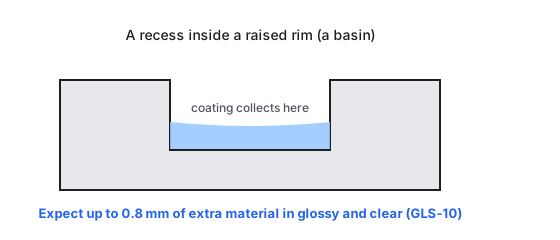
In glossy and clear, coating collects in a recess inside a raised rim. Expect up to 0.8 mm of extra material there (GLS-10).
Coating is thin on open, flat, vertical faces and much thicker anywhere liquid can collect. Design for where the coating goes.
| Zone | What happens | Allowance | Rule |
|---|---|---|---|
| Basin (a recess inside a raised rim) | Fills with coating | 0.8 mm | GLS-10 |
| Down-facing edge | A bead forms as coating drains during cure | 0.9 mm | GLS-11 |
| Crease narrower than 1 mm | Partly fills | 0.5 mm | GLS-12 |
| Raised thin feature (rim, ring, whisker) | Deviates after glossy | 0.6 mm | PRO-08 |
| Near-touch gap, 0.05–0.8 mm | Coating bridges it unpredictably | Fuse it, or open it to ≥0.8 static / ≥1.0 moving (mm) | GLS-13 |
Clear resin
Clear resin prints cloudy. It turns transparent only after every visible face is polished or coated, so clear finished glossy follows every glossy rule, with extra cosmetic demands: every warp, sink and change in thickness shows through.
| Rule | Name | Limit (mm, per side for gaps) |
|---|---|---|
CLA-01 | Clear always follows GLOSSY | CLEAR parts inherit every GLOSSY rule, including 2× closed-wall clearance. |
CLA-02 | Separate print and finish | Mating clear parts are printed and finished separately; print-in-place is not allowed. |
CLA-04 | Uniform thickness | Avoid thickness changes greater than 2:1 on visible clear regions; thick zones look cloudier and can yellow faster. |
CLA-05 | Internal parts | Parts visible inside a clear shell are finished and assembled after the shell; never enclosed during printing. |
CLA-06 | Fillet every internal corner on clear parts | Internal corners on CLEAR parts need fillets r ≥0.5 mm (1.0 mm preferred). Sharp corners craze and crack, and the whitening is visible. min radius: 0.5; preferred: 1. |
CLA-07 | No supports on visible clear faces | Support contact points leave visible scars in clear resin. Orient so supports touch only hidden faces; if impossible, REVIEW. |
CLA-08 | Solid clear sections and hardware | Solid clear sections thicker than 10 mm are REVIEW (internal stress, cloudiness, yellowing). Holes must be ≥3 mm from apexes and edges. Never press-fit pins, bails or eye-pins into clear resin; glue into a hole with 0.1–0.2 mm clearance per side. max solid thickness: 10; hole to apex/edge: 3; glue clearance per side: 0.1–0.2. |
Use instead
- Wrong move: a glossy part with gaps of 0.05 to 0.8 mm. Why: coating bridges them unpredictably (
GLS-13). Right move: fuse the surfaces with a fillet, or open the gap to ≥0.8 static / ≥1.0 moving (mm). - Wrong move: glossy over a fine or deep texture. Why: coating pools, traps bubbles and fills the detail (
GLS-09). Right move: use matte, or open texture cells to at least 1.5 mm and keep them shallower than they are wide. - Wrong move: a clear part with sharp inside corners or a pressed-in pin. Why: sharp corners craze white and pressed hardware cracks clear resin (
CLA-06,CLA-08). Right move: fillet inside corners at least 0.5 mm and glue hardware into a hole.
Last checked: 2026-11-09. Womp version: Womp web app, November 2026.