Protrusions and loops
How thick pins, horns, fingers, handles, rims and hanging loops must be to survive.Use this when: part of the model sticks out from the body, or the model hangs from a loop, bail or keyring.
Don't use this for: walls and holes. Read Walls and holes.
Protrusions fail as levers. To pass automatically a protrusion must meet two conditions: its thickness is at least the table value for its length, and at least its length divided by 5 (PRO-01, PRO-02). Above about 12 mm long for matte, or 15 mm for glossy, the 5 to 1 ratio governs. Features attached along their whole length, like sculpted hair, can be much thinner than free ones (PRO-04).
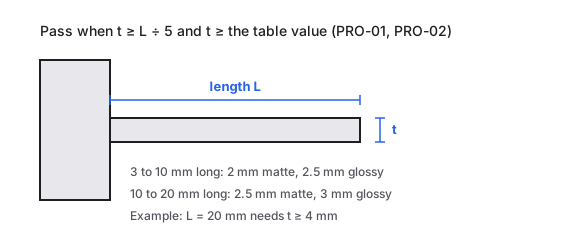
A protrusion passes when its thickness t is at least its length L divided by 5, and at least the table value for its length (PRO-01, PRO-02). A 20 mm pin needs at least 4 mm.
| Free length | Matte | Glossy | Rule |
|---|---|---|---|
| Up to 3 mm | 1.2 mm | 1.5 mm | PRO-01 |
| 3 to 10 mm | 2 mm | 2.5 mm | PRO-01 |
| 10 to 20 mm | 2.5 mm | 3 mm | PRO-01 |
| Over 20 mm | 3.0+ REVIEW | 3.5+ REVIEW | PRO-01, PRO-03 |
| Rule | Name | Limit (mm, per side for gaps) |
|---|---|---|
PRO-01 | Protrusion thickness by length | Minimum thickness for features sticking out from the body. ≤3 mm: MATTE: 1.2; GLOSSY: 1.5; 3–10 mm: MATTE: 2; GLOSSY: 2.5; 10–20 mm: MATTE: 2.5; GLOSSY: 3; >20 mm: MATTE: 3.0+ REVIEW; GLOSSY: 3.5+ REVIEW. |
PRO-02 | 5:1 length/thickness | AUTO_PASS requires thickness ≥ table value AND thickness ≥ length ÷ 5. Above ≈12 mm the ratio governs. |
PRO-03 | Long protrusions | Any free protrusion longer than 20 mm is REVIEW at minimum. |
PRO-04 | Supported strands | Strands attached along their full length: MATTE 0.8 mm, GLOSSY 1.0 mm. |
PRO-05 | Anatomy and handles | Fingers 1.5–2.0 (GLOSSY 2.0–2.5); horns/antennae 2.0–3.0+ (2.5–3.5+); handles/stems 2.5–3.0+ (3.0–3.5+). |
PRO-06 | Root neck and fillet | The narrowest neck is at least as thick as the feature it carries, with a fillet radius ≥0.5 mm. |
PRO-07 | Load-bearing loops | Hanging loops, bails and keyrings: section ≥3.0 mm MATTE, ≥3.5 mm GLOSSY/CLEAR, always tested. MATTE: 3; GLOSSY: 3.5; CLEAR: 3.5. |
PRO-08 | Raised thin features (rims, rings, loops on the body) | Thin features that stand off the body and connect at only a few points (glasses frames, earrings, bag rings, necklaces, whiskers) deviate 0.6–1.0 mm after glossy. Section ≥1.2 mm matte / ≥1.5 mm glossy, anchored to the body at least every 10 mm, or fused along their length. Expected allowance 0.6 mm. MATTE section: 1.2; GLOSSY section: 1.5; max anchor spacing: 10; allowance (GLOSSY): 0.6. |
PRO-09 | Rod with an end mass on a hanging part | A thin rod carrying a mass at its tip (wand, lollipop, flower stem) on a part that hangs or swings must pass PRO-02 (L/5): swinging adds whip loads the static index does not capture. |
Use instead
- Wrong move: a thin hanging loop on a keychain. Why: loops carry the whole part's weight and get snagged. Right move: a loop section of at least 3 mm matte or 3.5 mm glossy and clear (
PRO-07). Loops are always tested. - Wrong move: a thin rod with a mass at its tip, like a wand or a flower stem, on a part that hangs. Why: swinging adds whip loads. Right move: make the rod pass the 5 to 1 ratio (
PRO-09). - Wrong move: a thin rim or ring touching the body only at its ends. Why: it deviates after glossy and breaks. Right move: anchor it at least every 10 mm or fuse it along its length (
PRO-08).
Last checked: 2026-11-09. Womp version: Womp web app, November 2026.