
Strength and warping
How resin and finish affect strength, how narrow necks break, and how flat panels and long bars warp.Use this when: a part carries weight, has a narrow neck, or has large flat panels or long straight bars.
Don't use this for: minimum wall or detail sizes. Read Walls and holes, or Detail and lettering.
Resin
Matte and glossy are finishes, not strength grades (MAT-01). Standard resin is strong but brittle: thin features snap when bent, snagged or dropped (MAT-02). For the materials you can order, see Materials and finishes.
Breakage at narrow necks
A feature can pass every thickness rule and still snap because of what it carries. For each narrow neck, the breakage index is R_b = m · L / d³: the mass beyond the neck in g, the distance from the neck to that mass's centre in mm, and the neck diameter in mm (BRK-01). Stress rises in step with mass and lever, and falls with the cube of the diameter: doubling the diameter cuts stress 8 times.
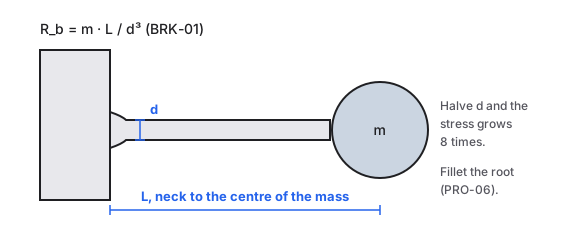
The breakage index is R_b = m · L / d³ (BRK-01). Halving the neck diameter makes the stress 8 times higher. Widen the neck and fillet its root (PRO-06).
| Rule | Name | Limit (mm, per side for gaps) |
|---|---|---|
BRK-01 | Breakage index | For each narrow neck: R_b = m · L / d³ (g, mm). m = mass beyond the neck; L = neck to that mass's centre; d = neck diameter. |
BRK-04 | Flat necks | For a rectangular neck of width b and thickness t bending about t: σ ∝ m·L/(b·t²). Use d_equiv = (b·t²)^(1/3) in R_b. |
BRK-05 | Deflection is different | Tip sag of a round cantilever scales with m·L³/d⁴; use for floppiness, not breakage. |
Warping
Warping is distortion without any load, from uneven curing shrinkage. The warp index is R_w = L² / t: the longest unsupported flat span over the wall thickness (WRP-01). Doubling the span makes warp about 4 times worse; doubling thickness only halves it. Ribs and curves usually fix warping better than extra thickness.
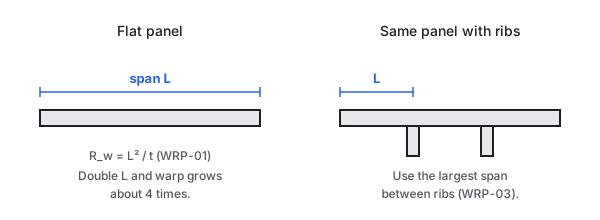
The warp index is R_w = L² / t (WRP-01). Ribs divide a panel, so L becomes the largest span between ribs (WRP-03).
| Rule | Name | Limit (mm, per side for gaps) |
|---|---|---|
WRP-01 | Warp index | R_w = L² / t (mm). L = longest unsupported flat span; t = wall thickness. Derived from δ ∝ Δε·L²/t. |
WRP-03 | Effective span with ribs | Ribs, bosses and folds divide a panel; use the largest sub-panel span between stiffeners. |
WRP-04 | Thicker is not always safer | Very thick or uneven sections can increase shrinkage gradients; combine with WAL-06. |
WRP-05 | Mitigations | Add ribs, curve the surface, add edge returns, even out thickness, hollow thick regions, flag orientation. |
Use instead
- Wrong move: thickening a large flat panel to stop it warping. Why: warp grows with the square of the span, and very thick or uneven sections shrink unevenly (
WRP-04). Right move: add ribs to shorten the free span, curve the surface, or add edge returns (WRP-03,WRP-05). - Wrong move: a heavy head on a thin neck. Why: breakage stress falls with the cube of the neck diameter. Right move: widen the neck and fillet its root at least 0.5 mm (
PRO-06).
Last checked: 2026-11-09. Womp version: Womp web app, November 2026.